Other stuff

Israel, Palestine and America
What has been happening in Israel and the Palestinian territories for the last several decades is nothing short of a human tragedy. And all three of the parties involved are to blame, in my opinion.
Israelis live in fear, certainly, and deserve our support for their efforts to protect themselves, but Israel is by and large a prosperous, safe country for its 10 million residents.
Palestinians, on the other hand, live in misery, and have for decades. The Gaza Strip is about 25 miles long and 5 miles wide, and is home to about 2 million people who are basically living in an open-air prison. Their international travel is controlled by Israel and thus severely limited. Their southern border is controlled by Egypt and has been closed off-and-on for decades due to terror activities by Hamas. All international aid goes through Israel, which has shown no reluctance to restrict that aid or shut it off completely.
Speaking of Hamas, the last election in Gaza was in 2007, while the average age of Gazans is 20, meaning that most of them have never voted for any of their leaders. Yet Hamas is not just a terror organization, it also runs the government, the hospitals, the schools, every aspect of official life. And represses its opposition. So it's fair to say that just because they're in power doesn't mean they represent the people's actual interests and values.
In the West Bank, Palestinians are largely seen as obstacles for "settlers" who want to restore the land to its millennia-old borders. Palestinian farms are walled off and roads built through them to ease access between by Jewish "settlements" (they range in size from about 100 residents to more than 80,000).
And while I know this is not the specific policy of Israel, some of their leaders have tacitly or actively supported these actions over the decades. Benjamin Netanyahu once bragged about "mowing the grass" in Gaza by launching sporadic military operations it claims are hurting Hamas' capabilities for terror. Hamas just regrouped; Israel just waited a few months and did it again. The only real change was the Palestinians' suffering.
When Donald Trump negotiated the Abraham Accords -- a landmark peace agreement among several Arab countries and Israel -- he did not include the Palestinians. The Israel-Palestine conflict is a major source of unrest across the Middle East, yet one half of the equation was left out of the talks.
I spoke with a Jewish gentleman a few weeks ago, who thought the best solution would be a unity government, and a truth and reconciliation commission like what has helped South Africa heal much of its past. But I think what's happening in Israel and Gaza is generations deep, and it will be a long time, if ever, before they could ever live under the same government. In my opinion, the only viable solution is for there to be two separate, autonomous states, and the United States should make helping that come about its primary goal, No more silence and status quo.

Our House, divided
I think the beginning of our latest great national divide began in the 1980s, when then-candidate Ronald Reagan would charm his audiences by saying "The nine most terrifying words in the English language are: I'm from the government, and I'm here to help." The audience laughed, but they were being subtly taught to view government and government employees as the enemy of the people.
It's been the Republican mission ever since. Grover Norquist famously said in 2001: "I don't want to abolish government. I simply want to reduce it to the size where I can drag it into the bathroom and drown it in the bathtub." We've all seen what Elon Musk and his DOGE employees did in 2025, with massive, across-the-board firings regardless of the consequences. Thousands of probationary federal workers who were abruptly fired were ordered reinstated by a federal court, while several agencies rehired laid-off staff after severe cuts hindered basic operations, but the damage done to our institutions will take decades to repair.
Republican Speaker of the House Newt Gingrich changed the House dramatically during his tenure from 1995 to 1999. He shifted the focus of congressional campaigns from local constituent services to broad, nationalized platforms, such as his 1994 "Contract with America," which forced candidates to pledge fealty to a single, nationalized party agenda. He centralized power, abolished independent research agencies, and punished freshmen lawmakers who attempted to form bipartisan friendships. And he normalized the use of government shutdowns as leverage in budget battles.
It's only gotten worse. He and every Republican speaker who followed him has resigned in disgrace or disgust. The current speaker only got the job after Kevin McCarthy was ousted after only nine months on the job, and three other candidates failed to garner enough support. And it took him four votes to do it. Not so much a popular leader as a last resort after three weeks so they could get back to business.
There are many reforms that would make the House more representative of the people it serves. They should be the first thing a new Congress does, so that the new speaker will abide by them. Here are a few:
1) Restoring a more open amendment process on the House floor. Allowing more floor amendments, rather than restricting them through the Rules Committee, encourages members to work across the aisle on compromises and policy refinements.
2) Lowering the number of signatures required on a discharge petition (and allowing private signature collection) to force floor votes on bills that have substantial bipartisan support, even if party leadership opposes them.
3) Rebuilding the committee system so that bills are actually debated, marked up, and advanced by members rather than pre-negotiated by leadership. This includes encouraging bipartisan committee retreats and improving shared access to nonpartisan staff resources.
4) Closing loopholes so that bills reaching a high threshold of co-sponsors (e.g., 290 members) are automatically granted a floor vote, ensuring bipartisan legislation gets a fair hearing.

The US Parks Service
This one's next.

A no-win scenario
In 2015, after more than 18 months of negotiation between Iran and the United States, China, Russia, France, the United Kingdom, Germany, and the European Union, the Joint Comprehensive Plan of Action was finalized. It was only a framework, and never officially signed, but it was an international agreement to limit Iran's nuclear program in exchange for sanctions relief. Israel has always opposed the deal.
In May 2018, President Donald Trump withdrew the U.S. from the agreement and reimposed heavy sanctions. Iran responded by gradually exceeding the nuclear limits on uranium enrichment and stockpiles previously set by the JCPOA.
In March 2026, President Trump launched a war against Iran, to "obliterate" Iran's nuclear capability. As of late July, the war is still ongoing, although the reason for it has shifted several times.
What cannot be denied is that this war has cost America tens of billions of dollars, depleted our armaments, and alienated our European allies needlessly. There are only two ways of knowing what Iran is doing: Either by invitation or forcibly. The JCPOA would have allowed inspectors in; we could have debated their reports. Now it seems our only option is military, and I think that, whatever we do with weapons, we won't truly know anything until we go in with boots on the ground, and even then we won't know everything.
The Iran war has been a disaster for America, in every way.
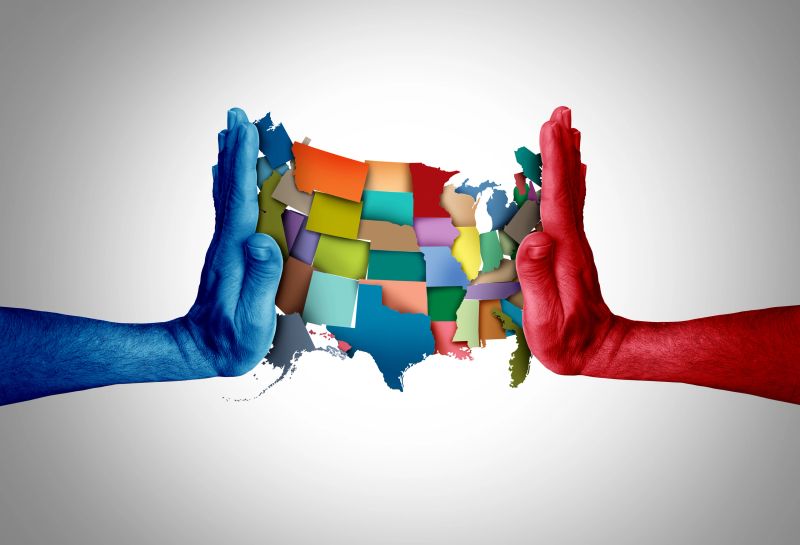
Their way or the highway
I'm basically a social libertarian. By that I mean, that if whatever you want to do is conducted by informed, consenting, responsible adults, I have no objection to it. You can't legislate someone's conscience.
But our two major political parties seem intent on forcing their views on the entire country. Republicans seem to have been taken over by a particularly evangelical branch of Christianity, perhaps best represented by Texas, where the State Board of Education will require students to read specific Bible passages starting in the 2030–31 school year.
Democrats, meanwhile, have no problem using the government to advance their own agenda of social justice, civil rights, and a social safety net. While those are noble goals, they are also a source of deep division.
Both sides are trying to legislate morality, which only serves to divide our country further.
That's why I believe the only way forward for our country is by focusing on larger issues. I don't think the federal government should have any say whatsoever on transgender women in sports. At a recent forum, one of the other candidates suggested leaving it up to the organizations that run the sports themselves. As he put it, "I don't think anyone is worried about badminton being overtaken." I think that's an equitable solution to a difficult situation.
Whenever possible, I pledge to press for larger issues, that we all as Americans -- indeed, as humans -- face.

The end is near
July 17: I've received my Voters' Pamphlet and my ballot, so I presume you have also. Here a few things I've learned and thought about during the campaign season.
I think that, while my message of bipartisanship and progressiveness have been well-received (I've gotten applause for several of my lines), I'm a poor messenger. I'm not good at public speaking before a crowd, although I've had excellent conversations with small groups. Ah well. I've always known I'm a dark horse in this race, because I don't have the campaign organization, and I'm not spending money, but I sincerely hope some of the ideas I've been putting forth catch on with whoever advances to the general election.
I was glad to receive an email inviting me to sign the Purple Pledge (https://iseepurple.org/purple-pledge/), to always put the country before my party, to support a code of ethics for all public officials, to protect free and fair elections, and many more important civic functions.
July 28: My campaign has always been a leap of faith and a social experiment. The leap was my trying to get a message of optimism into the public debate. I have seen some success in that, as some of the other candidates have been saying some of the things I've been saying. I hope it lasts. The social experiment has been trying to find out how to get that message out without the massive amounts of money typically spent (it's in the millions). On that, I don't think I've been very successful. I think this is a great website, and I think it tells voters more about me and my ideology than any other candidate's site, but according to GoDaddy, I haven't had the tens of thousands of visitors I'll need to make it past August 4. The only thing I would do with more money is to send a well-written letter to every voter, telling them about this site. Ah, well. To quote Bon Jovi: Like Frankie said, I did it my way.